There are no items in your cart
Add More
Add More
| Item Details | Price | ||
|---|---|---|---|

Where the official MYP maths exams really are, how to get them, and how to practise by criterion, with a free 20-mark task to try.
Wed Nov 11, 2026
It is late, the eAssessment is getting closer, and you type "MYP maths past papers" into Google. You get blurry PDFs, sites that want a sign-up before showing anything, and files with no mark scheme. Some of them are not even the right course.
This guide explains where MYP maths past exams really are, how to get to them, and how to practise properly when you can't.
The short answer
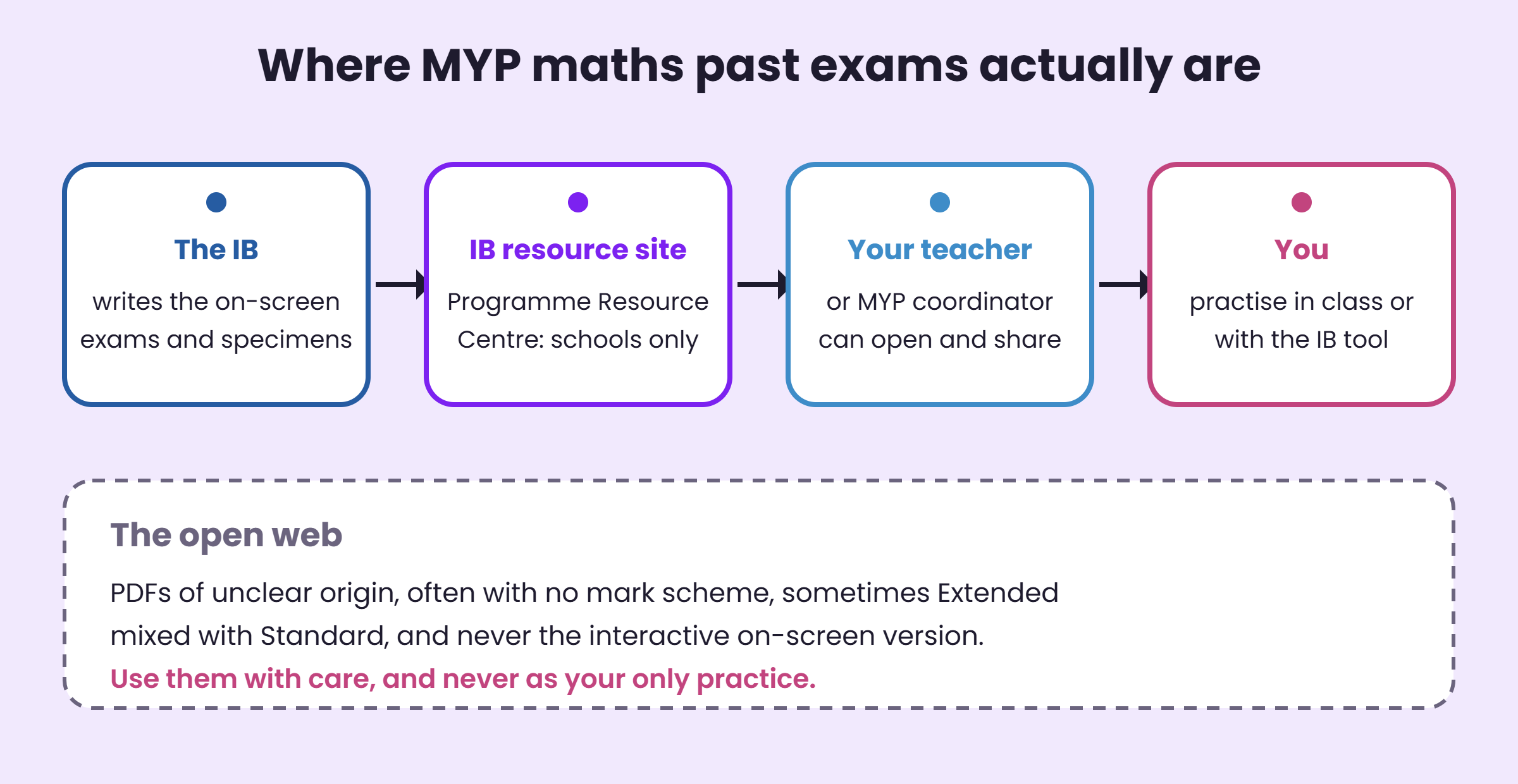
The IB does not publish MYP maths past exams on the open web. Past on-screen exams and specimen exams sit on the IB's Programme Resource Centre, which only IB World Schools can log into. Ask your maths teacher or MYP coordinator for them, then practise by criterion, not just by paper.
In this guide
MYP maths is assessed by a two-hour on-screen examination: 100 marks, three tasks, and 25 marks for each of the four criteria. Criterion C (communicating) is marked in all three tasks, not in a section of its own. All of this comes from the IB's own subject brief for MYP mathematics.
According to the IB's page on preparing for on-screen exams, the full range of specimen examinations is kept on the password-protected Programme Resource Centre, and schools can also use a familiarisation tool so students get used to the on-screen tools before exam day. The IB's eAssessment Q&A material describes past session materials sitting in the same place, under the specimens and past session section.
In plain words: the real papers exist, but they are behind a school login. A parent or student searching from home will not find the official versions, which is why so many people think MYP maths past papers don't exist.
What to say to your teacher
"Could we try one of the specimen MYP maths exams on the IB's on-screen tool before the mock? I'd like to practise with the real format."
Teachers can open these through the school's account, so asking early helps.
Sources: IB, MYP mathematics subject brief; IB, Preparing for an exam; IB, MYP eAssessment webinar Q&A. All IB material is credited to the International Baccalaureate Organization.
Even when you do get a past paper, sitting it once and checking the score tells you surprisingly little. The exam is built criterion by criterion, so your practice should be too.
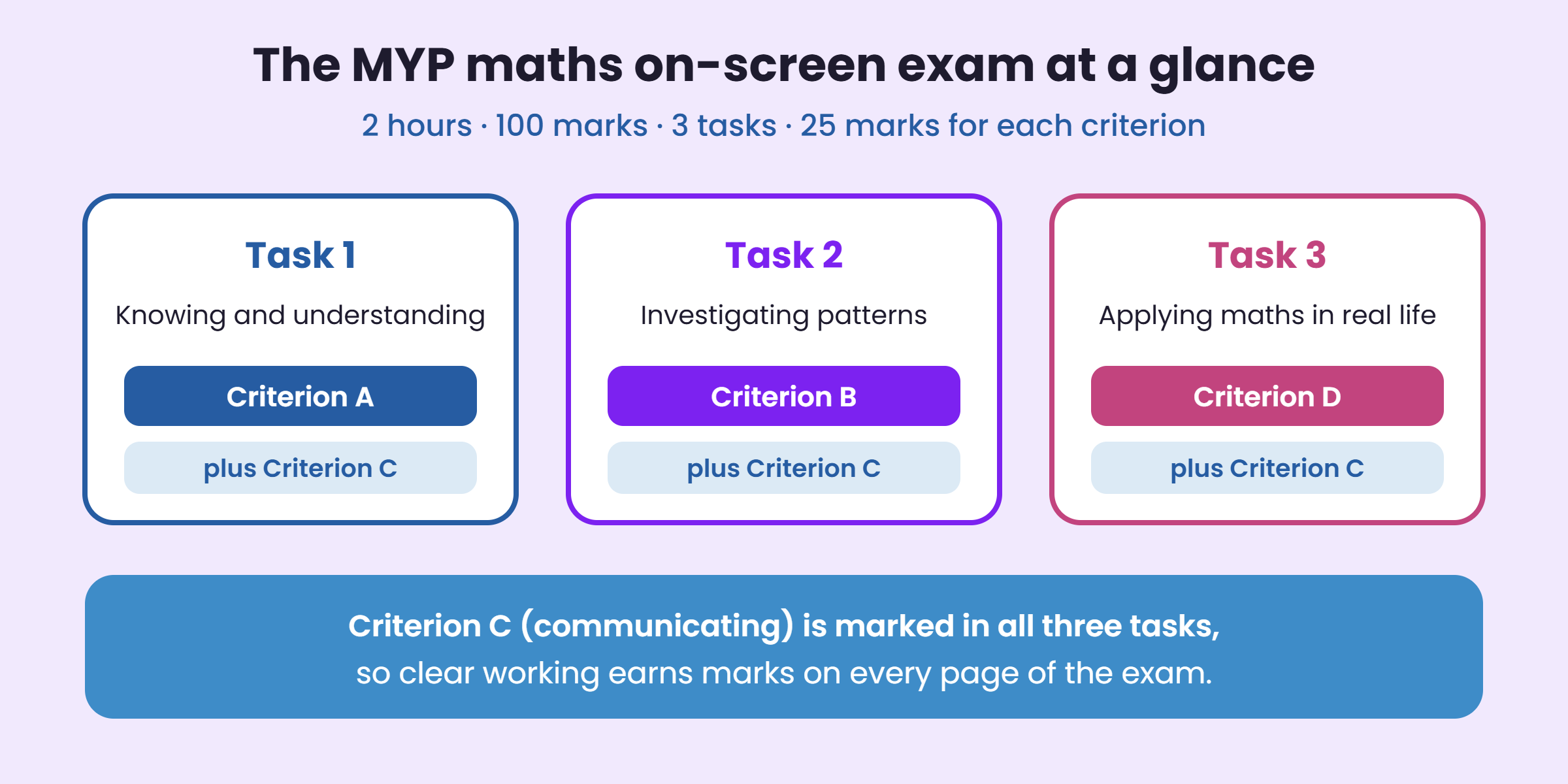
Here is the difference in practice. Two students both score 60 out of 100 on a mock. One lost most of the missing marks in the investigation (Criterion B), the other lost them by writing answers with no units or reasoning (Criterion C). They need completely different revision, and a single total hides that.
So use every paper three ways:
Quick check: which practice do you need? (tap each one)
You are probably losing Criterion C marks: missing units, unclear steps, or no closing sentence. Practise writing full solutions and mark only the communication.
That is Criterion B. Practise investigations: test cases, describe the rule in words, write it in symbols, then verify and justify it. Verify or Justify? walks through the top levels.
That is about command terms, and it costs marks in B, C and D. MYP Maths Command Terms shows what each one asks for.
Sit full papers under a timer, and note where the minutes go. It is easy to spend too long on early, low-mark parts and rush the long tasks at the end.
This short task touches four criteria, so you can practise the way the exam is marked. You need a pen, paper and one long strip of paper (a till receipt or a strip cut from A4 works well). Allow about 25 minutes.
Folding paper
20 marks in total: Criterion A 4, Criterion B 6, Criterion C 5, Criterion D 5
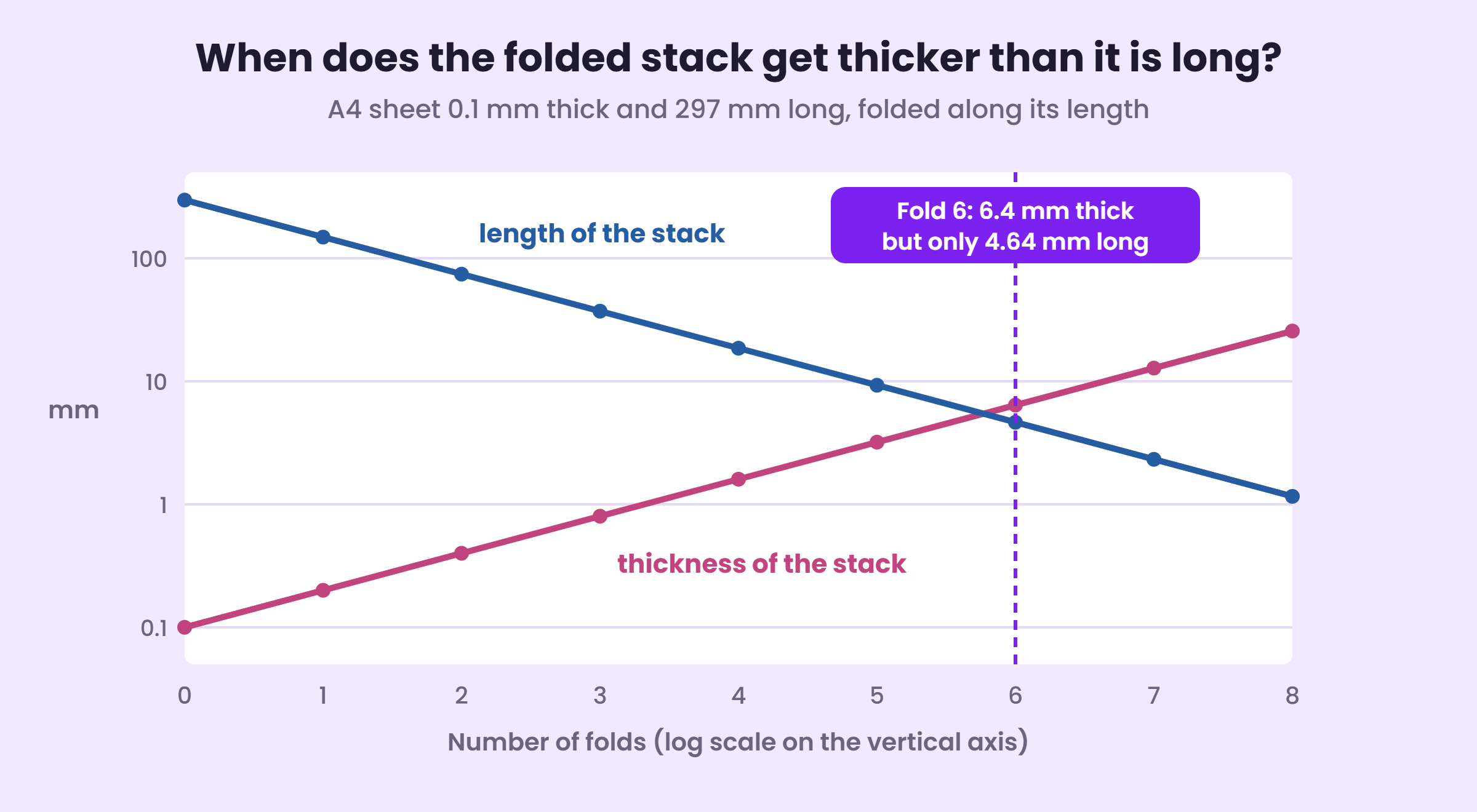
A sheet of A4 paper is 0.1 mm thick and 297 mm long. Each fold halves the length and doubles the thickness.
Question 1 [A 4, C 1]
(a) Find the thickness of the folded paper after 5 folds. [2]
(b) Find the thickness after 20 folds. Give your answer in metres, in standard form, correct to 3 significant figures. [2]
Question 2 [B 6, C 2]
Fold a strip of paper in half, always folding the right end over onto the left end. Unfold it and count the crease lines. One fold gives 1 crease, two folds give 3 creases and three folds give 7 creases.
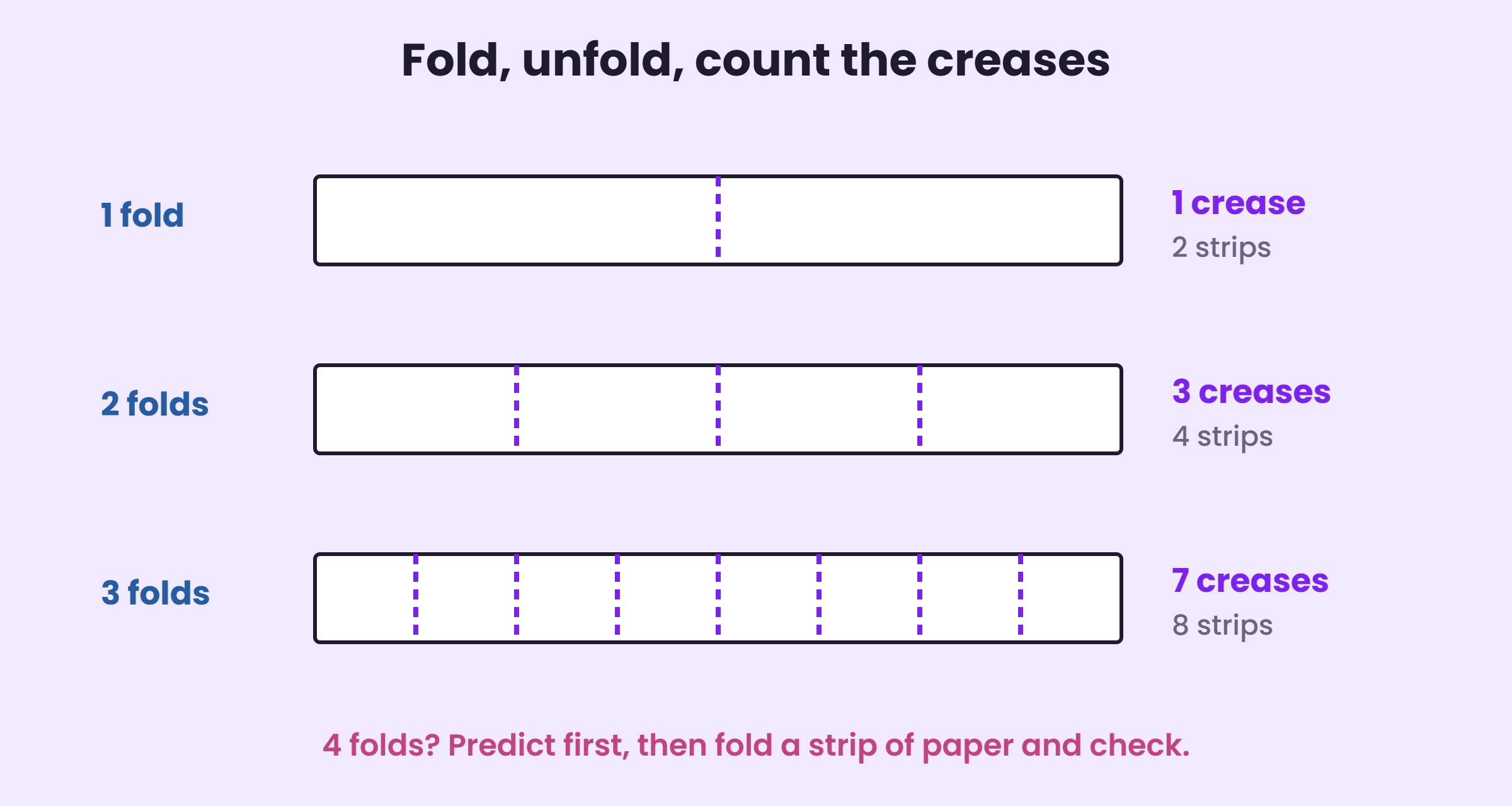
(a) Predict the number of creases after 4 folds. Check by folding. [1]
(b) Find a general rule for the number of creases, C, after n folds. [2]
(c) Verify your rule for n = 5. [1]
(d) Justify why your rule works. [2]
Question 3 [D 5, C 2]
A student claims that if you could keep folding the A4 sheet along its length, the stack would soon reach the ceiling of a room 3 m high.
(a) Find the least number of folds needed for the stack to be taller than 3 m. [2]
(b) Find the length of the stack after that many folds. [1]
(c) Comment on whether the student's model is reasonable. [2]
Stuck? Open one hint at a time.
After 1 fold the thickness is 0.1 × 2, after 2 folds 0.1 × 2 × 2. What is it after n folds? Watch the units: millimetres to metres means dividing by 1000.
Look at the numbers 1, 3, 7. Add 1 to each one. Then count the strips in the picture, not just the creases.
Compare the thickness of the stack with its length after each fold. A stack can't be folded again if it is thicker than it is long.
Try the whole task first. Then open each part and mark yourself.
(a) Thickness after n folds = 0.1 × 2n mm.
After 5 folds: 0.1 × 25 = 0.1 × 32 = 3.2 mm.
(b) After 20 folds: 0.1 × 220 = 0.1 × 1 048 576 = 104 857.6 mm.
104 857.6 mm ÷ 1000 = 104.8576 m = 1.05 × 10² m (3 s.f.).
That is taller than a 25-storey building, from one sheet of paper. The C mark here is for correct units on both answers.
(a) The pattern 1, 3, 7 roughly doubles each time. Adding 1 gives 2, 4, 8, which are powers of 2. So the prediction for 4 folds is 24 − 1 = 15 creases, and folding a strip confirms it.
(b) In words: the number of creases is one less than 2 to the power of the number of folds.
In symbols: C = 2n − 1, where C is the number of creases and n is the number of folds.
C marks: the rule in words and in symbols, with both letters defined.
Rule: C = 25 − 1 = 32 − 1 = 31.
Check: after 5 folds the paper has 25 = 32 layers, so the unfolded strip shows 32 equal sections and 31 creases between them. Counting a folded strip gives 31. The rule is verified for n = 5.
Verifying means a new case checked two ways: by the rule and by the paper. Testing a case you already used to find the rule does not count.
Each fold doubles the number of layers, so after n folds there are 2n layers. When the strip is unfolded, those layers lie side by side as 2n equal sections. A crease separates each pair of neighbouring sections, and 2n sections in a line have 2n − 1 gaps between them. So C = 2n − 1 for every n.
This is the top-level move: explaining why the rule must hold, not just showing that it does. The IB's Criterion B wording for MYP 5 asks students to "prove, or verify and justify, general rules" (MYP Mathematics guide, IB).
(a) 3 m = 3000 mm. Need 0.1 × 2n > 3000, so 2n > 30 000.
214 = 16 384 gives 1638.4 mm = 1.64 m, not enough.
215 = 32 768 gives 3276.8 mm = 3.28 m.
So 15 folds.
(b) Length after 15 folds = 297 ÷ 215 = 297 ÷ 32 768 ≈ 0.0091 mm.
A weak answer: "The model is not reasonable because you can't fold paper that many times." This is true but gives no evidence, so it earns little.
A strong answer: The model predicts a stack 3.28 m tall but only about 0.009 mm long, which is impossible. In fact the model stops working much earlier. After 5 folds the stack is 3.2 mm thick and 9.28 mm long, but after 6 folds it would be 6.4 mm thick and only 4.64 mm long. Once the stack is thicker than it is long it can't be folded in half again, so the model is only reasonable for about the first 5 folds. The student's claim is not reasonable.
The difference is evidence from the model itself, a clear limit, and a closing sentence that answers the question. That is what a Criterion D comment needs.
Score yourself
Write your marks for each criterion: A out of 4, B out of 6, C out of 5, D out of 5. The lowest one, compared with what it could be, tells you what to practise next. That is the whole point of marking by criterion.
Unfold your strip and look at which way each crease points: some dip down (valleys) and some stand up (mountains). Count each kind for 1, 2, 3 and 4 folds. Find a rule for each kind, and check that the two rules add up to 2n − 1.
Answer: one kind always has 2n − 1 creases and the other 2n − 1 − 1, which add to 2n − 1.
You don't need hundreds of past papers. You need a short list of the question types that cost you marks, and fresh practice on each one. Keep a simple tracker like this after every paper or task:
| Criterion | Marks scored | Where they went | Next practice |
|---|---|---|---|
| A | 19 / 25 | Standard form, rounding | 10 quick standard form questions |
| B | 11 / 25 | No justification | Two investigations, justify each rule |
| C | 16 / 25 | Missing units | Rewrite two old solutions in full |
| D | 14 / 25 | One-line comments | Three "comment on" parts with evidence |
The numbers above are an example, not real results.
Five steps to a question bank that works
Past on-screen exams and specimen exams are kept on the IB's Programme Resource Centre, which only IB World Schools can access. They are not on the public website, so ask your teacher or MYP coordinator.
There is no free official question bank on the public web. Your school's specimen and past exams, textbook exercises and original practice papers together make a good bank, especially if you sort them by criterion.
It is a two-hour on-screen exam worth 100 marks, with three tasks. Criteria A, B, C and D are worth 25 marks each, and Criterion C is marked across all three tasks.
Quality matters more than number. Three or four full papers, each marked by criterion and followed by targeted practice on your weakest criterion, are worth more than ten papers done once and forgotten.
Treat them with care. They may be incomplete, missing the mark scheme, or for a different course, and none of them give you the on-screen tools. Use them alongside, not instead of, the specimen exams your school can provide.
Want more practice in the exam format?
Try one full question from our practice papers free, with its mark scheme, or see all three original papers in Volume 1.
Informational Compass is an independent publisher and is not affiliated with or endorsed by the International Baccalaureate Organization. Questions: query.informationalcompass@gmail.com
 Launch your Graphy