There are no items in your cart
Add More
Add More
| Item Details | Price | ||
|---|---|---|---|

Verification gets you a 6. Justification gets you an 8. Here is the difference, with an original investigation task you can try.
Sun Oct 4, 2026
You found the rule. You checked it and it worked. You wrote "therefore my rule is correct" and moved on feeling fine about it. Then the mark came back as a 5, and nobody could tell you what the missing piece was.
The missing piece is almost always one word. Criterion B asks you to verify and justify, and those are two separate jobs. Most students do the first one, write a sentence that sounds like the second one, and lose the top band without ever knowing why.
THE SHORT ANSWER
Verifying means testing your rule on cases you did not use to build it, and showing it gives the right answer. Justifying means explaining the structural reason your rule has to work, for every case, including the ones you never tested. Verification gets you into the 5-6 band. Justification is what moves you to 7-8.
Criterion B is Investigating patterns, marked out of 8. For MYP Years 4 and 5, the third strand is written like this:
"prove, or verify and justify, general rules"
Read that again, because the punctuation is doing real work. You have two routes to the top band. Either you prove the rule formally, or you verify and justify it. The "and" is not decorative. Verifying on its own is not enough, and the achievement level descriptors confirm it:
| Level | What strand (iii) requires |
|---|---|
| 5-6 | verify the validity of these general rules |
| 7-8 | prove, or verify and justify, these general rules |
The gap between a 6 and a 7 in Criterion B is, quite literally, those two words.
It matters more in the eAssessment than in a classroom task, because the on-screen exam carries 100 marks split evenly across the four criteria, 25 marks each for A, B, C and D. Criterion B is a full quarter of your grade, and the investigation question is where most of those marks sit.
Both words are official MYP command terms, and both have published definitions. They are shorter than you would expect, and the difference is hiding in plain sight.
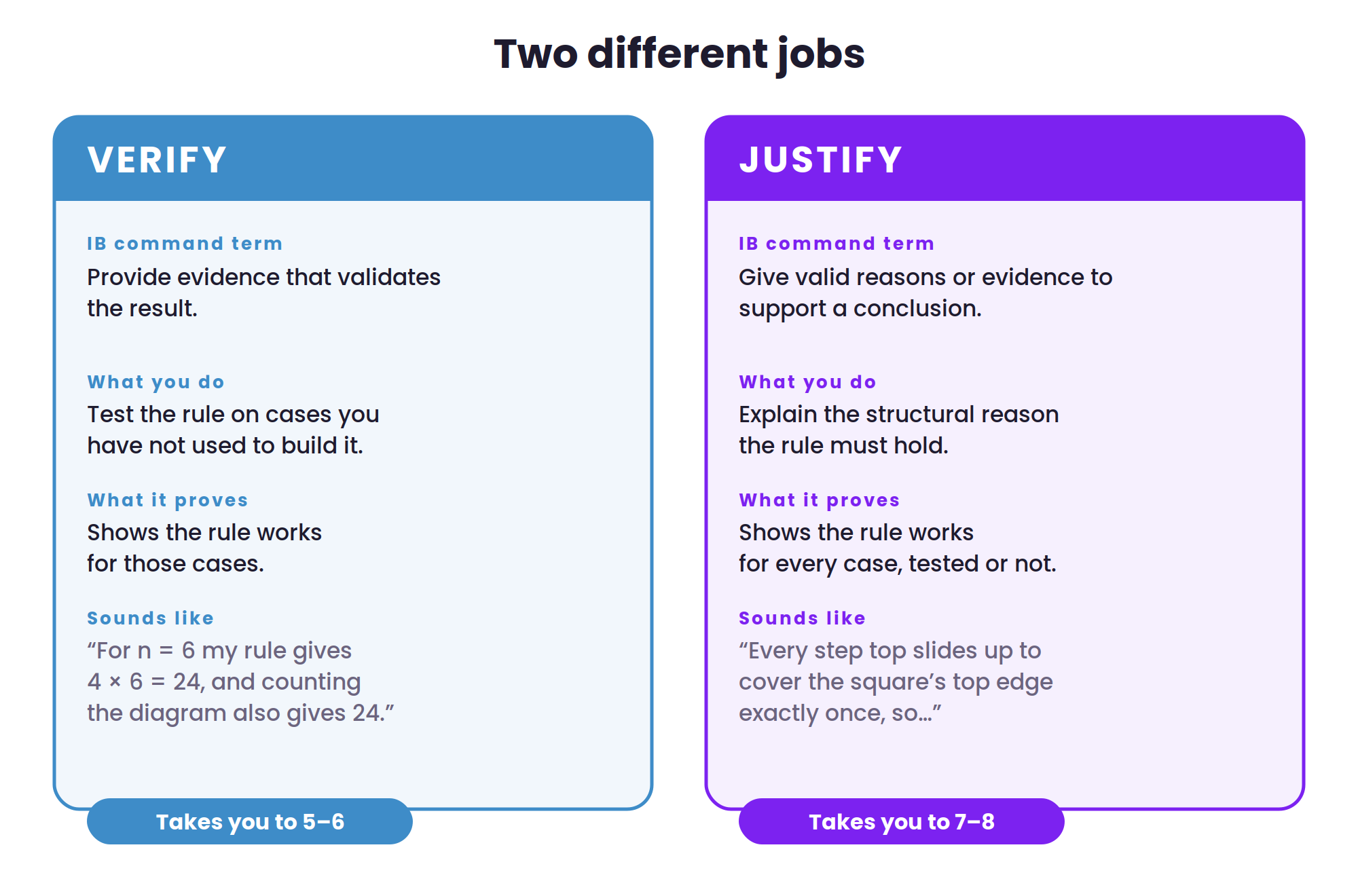
Verify: "Provide evidence that validates the result." You have a rule. You go and get evidence that it produces correct answers. In practice: pick a case you did not use when building the rule, work the answer out independently (count it, draw it, calculate it the long way), work it out again using your rule, and show the two agree.
Justify: "Give valid reasons or evidence to support an answer or conclusion." You explain why. Not why you believe it, and not how many times you checked it, but why the structure of the problem forces the rule to be true.
Here is the test that settles it. Ask yourself: does my explanation still work for a value of n that I never tested?
"I checked n = 6, n = 7 and n = 10, and it worked every time" does not survive that question. It says nothing at all about n = 11. But "each new step adds exactly one unit to the top and one unit to the side, so the total goes up by 4 every time" does survive it, because it describes what the shape does, not what you happened to observe.
Four students investigate the same pattern and write four different final sentences. The maths behind them is identical. The marks are not.
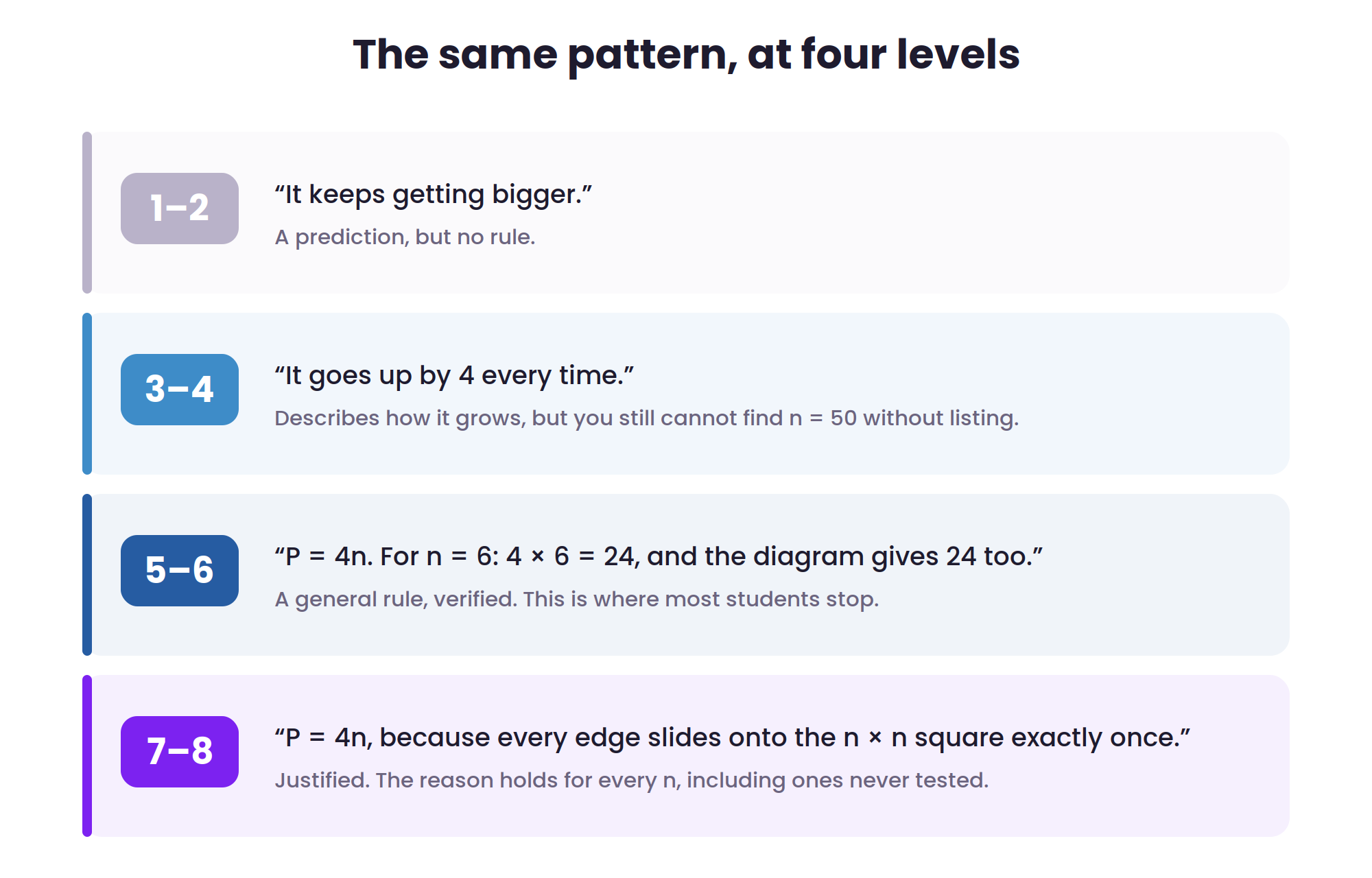
Notice where the jump happens. Levels 3-4 and 5-6 are both about what the pattern does. Only the top band asks why. And notice how short the level 7-8 sentence is: justification is not about writing more. It is about writing the one sentence that explains the mechanism.
This is an original task, written for this post. Give it a real attempt before you scroll to the solution. The whole point is what happens at part 5.
CRITERION B INVESTIGATION: THE GROWING STAIRCASE
A staircase is built from unit squares. Staircase n has n columns: the first column is 1 square tall, the second is 2 squares tall, and so on up to the nth column, which is n squares tall.
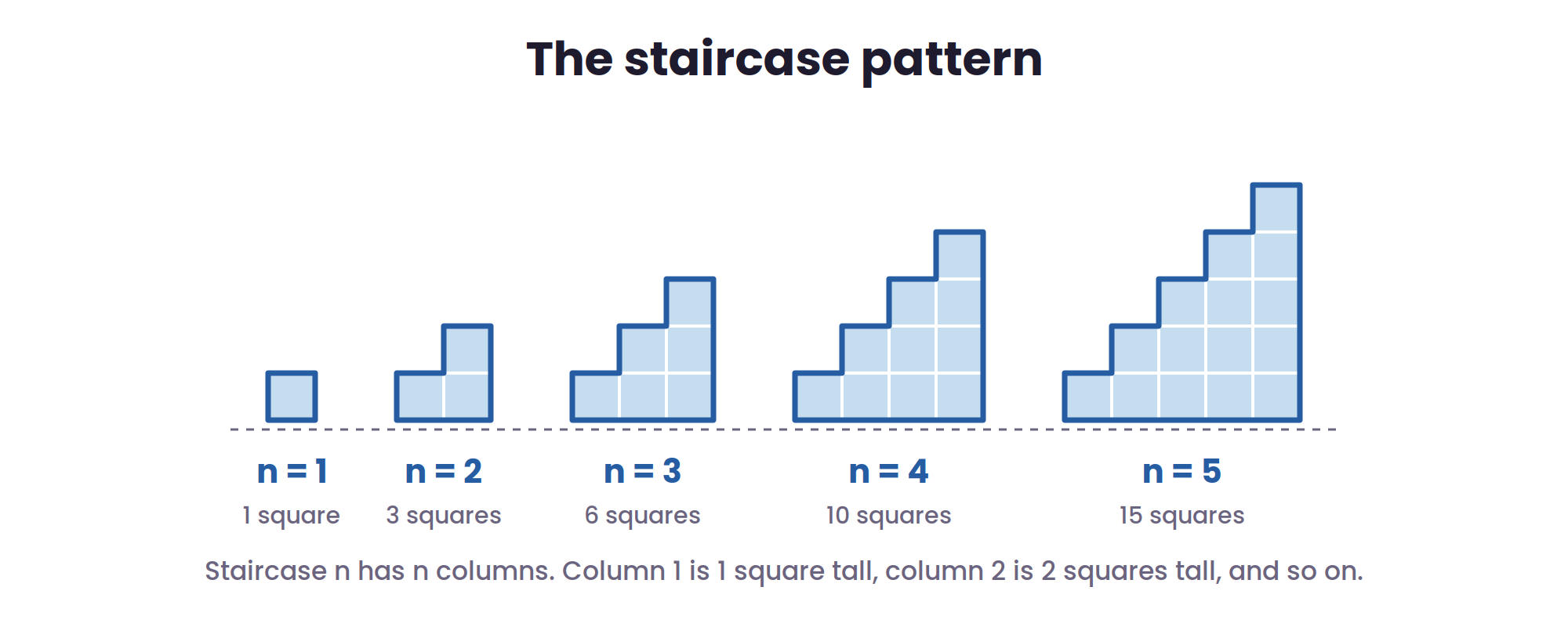
You are going to investigate the perimeter of the staircase, the total length of the outside edge, measured in unit lengths.
Extension. Now do the whole thing again for the number of squares in staircase n. Then explain why one of these two rules is much easier to justify than the other.
One warning before you start. Part 5 is not one instruction, it is two. Write them as two separate paragraphs, each with its own heading. Students who write a single blurred paragraph almost always end up having only verified.
Only open this once you have had a proper go.
| Staircase n | 1 | 2 | 3 | 4 | 5 |
|---|---|---|---|---|---|
| Perimeter P | 4 | 8 | 12 | 16 | 20 |
The perimeter increases by 4 each time. Since the results form an arithmetic sequence starting at 4 with a common difference of 4, staircase 10 should have perimeter 40, and drawing it out and counting the edges confirms that it does.
This is worth pausing on. The staircase gets dramatically bigger: staircase 5 has fifteen squares where staircase 1 has one, and yet the perimeter is only creeping up by 4 each time. That is surprising, and surprising is usually where the interesting justification is hiding.
P = 4n
Staircase 6 was not used to build the rule, so it is a fair test.
From the rule: P = 4 × 6 = 24.
Independently, by counting the edges of the diagram: the bottom edge is 6 units, the right-hand edge is 6 units, there are 6 step tops of 1 unit each, and 6 step sides of 1 unit each. That gives 6 + 6 + 6 + 6 = 24.
The two methods agree, so the rule is verified for n = 6.
This is where most students stop, and it is a completely correct piece of verification. It is also worth a 6, not a 7.
Every staircase n fits exactly inside an n × n square. Look at what happens to its edges.
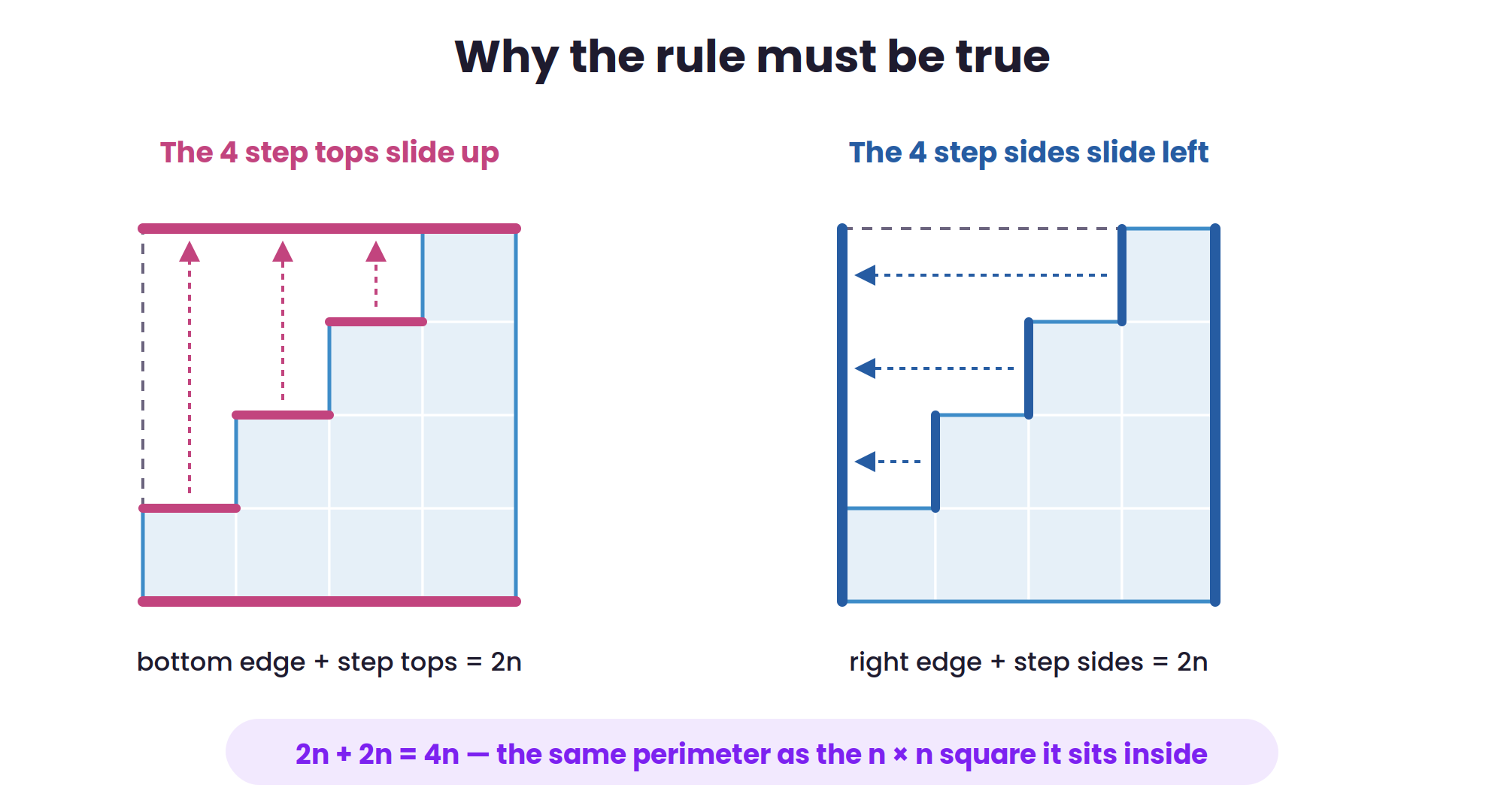
The horizontal edges. The staircase has one flat step top per column, each 1 unit long, and each sits above a different column. Slide them all straight up and they tile the top edge of the square exactly once, with no gaps and no overlaps: that is n units. The bottom edge of the staircase is already the bottom edge of the square, another n units. So the horizontal edges total 2n.
The vertical edges. The same thing happens sideways. There is one step side per column, each 1 unit tall, and each sits at a different height. Slide them all left and they tile the left edge of the square exactly once: n units. The right-hand edge of the staircase is already the right edge of the square, another n units. So the vertical edges total 2n.
Therefore the staircase has exactly the same perimeter as the square it sits inside: 2n + 2n = 4n.
Read that argument again and check it against the test: does it depend on n being any particular number? It does not. Nothing in it says "6" or "10". It works for n = 1000 and for every n you will never draw. That is what makes it a justification rather than a check.
The number of squares is 1 + 2 + 3 + … + n, giving
A = n(n + 1) ÷ 2
To justify it: take a second, identical staircase, rotate it by 180° and slot it against the first. The steps interlock perfectly and the two together form a solid rectangle n squares wide and n + 1 squares tall. One staircase is half of that rectangle, so A = n(n + 1) ÷ 2.
And the answer to the last part: the perimeter rule is easier to justify because the perimeter only depends on the outline, and the outline can be rearranged into a shape you already know. The area rule needs you to find a second copy of the shape before the structure appears.
One last thing worth noticing. At n = 7, the area and the perimeter are both 28. It is the only staircase where that happens. See if you can justify that.
Want to try this under exam conditions?
Each of the three papers in Volume 1 includes a full Criterion B investigation, with a mark scheme that shows where each mark is earned.
Justification is a habit, not a talent. These frames work for almost any pattern investigation, so keep them somewhere you will see them while you work.
To verify:
"I will test my rule on ___, which I did not use to find the rule. My rule predicts ___. Working it out directly from the diagram gives ___. These agree, so the rule is verified for this case."
To justify:
"Each time n increases by 1, ___ happens to the shape. This means ___ is added every time, which is exactly what the term ___ in my rule represents. Because this holds for any n, the rule must be true in general."
The words carrying the marks are because, each time, this means and for any n. If none of those appear anywhere in your final paragraph, you have almost certainly only verified.
The habit to build is small: every time you write a general rule, stop and ask yourself the one question. Would my explanation convince someone about a case I have never looked at? If the answer is no, you have verified. If it is yes, you have justified, and you are in the top band.
Want more investigations like this one?
Our IB MYP Standard Mathematics eAssessment Practice Papers, Volume 1 contains three full original papers with examiner-style mark schemes across all four criteria, including Criterion B investigations marked the way the real thing is marked, so you can see exactly where verification stops and justification begins.
 Launch your Graphy