There are no items in your cart
Add More
Add More
| Item Details | Price | ||
|---|---|---|---|

How to read an MYP maths mark scheme like an examiner: mark points, ACCEPT and DO NOT ACCEPT notes, error carried forward and level tables, with one answer marked line by line.
Sat Oct 31, 2026
You finish a practice question, open the mark scheme, and find a row that says ".3 their5.7 (ECF)". Your answer was 5.9. Did you get the mark or not? Most students guess, give themselves the mark, and learn nothing from the paper.
This post explains how an MYP maths mark scheme is read, line by line, so you can mark your own work the way an examiner would.
THE SHORT ANSWER
An MYP-style maths mark scheme gives 1 mark for each mark point (.1, .2, .3). ACCEPT lists other answers that still earn the mark; DO NOT ACCEPT lists ones that do not. ECF (error carried forward) means a mistake costs you once, not every time, but only if your working is written down. Long investigation and report parts use level tables: the highest level you reach includes the levels below it.
Contents
The MYP 4 and 5 Standard Mathematics eAssessment is a 2-hour on-screen examination worth 100 marks, with 25 marks for each of the four criteria: A Knowing and understanding, B Investigating patterns, C Communicating and D Applying mathematics in real-life contexts.
What each question asks you to do is set by its command term, and the IB publishes an official definition for every one (MYP: From principles into practice, Appendix 3). These five decide most of what a mark scheme looks for:
| Command term | IB definition | What the mark scheme rewards |
|---|---|---|
| Calculate | "Obtain a numerical answer showing the relevant stages in the working." | A method mark for the stages, then an accuracy mark for the value |
| Determine | "Obtain the only possible answer." | The one correct answer, usually with its working |
| Show that | "Obtain the required result (possibly using information given) without the formality of proof." | Every step, because the answer is already printed |
| Verify | "Provide evidence that validates the result." | Substituting and comparing, with a closing sentence |
| Justify | "Give valid reasons or evidence to support an answer or conclusion." | The reasons, not the answer on its own |
There is a full guide to these terms, with one fact asked five different ways, in MYP Maths Command Terms: What Each One Is Actually Asking You to Do.
One honest point before going further. The IB publishes the criteria and the command terms, but the MYP guide does not include a glossary of mark-scheme abbreviations. The words below (ACCEPT, ECF, mark points, level tables) are the ones you will meet in MYP-style maths mark schemes, including the ones in our own practice papers. Learn them once and every scheme becomes readable.
Every row is one mark. A 3-mark part has three rows, numbered .1, .2 and .3. Each row has four pieces of information.
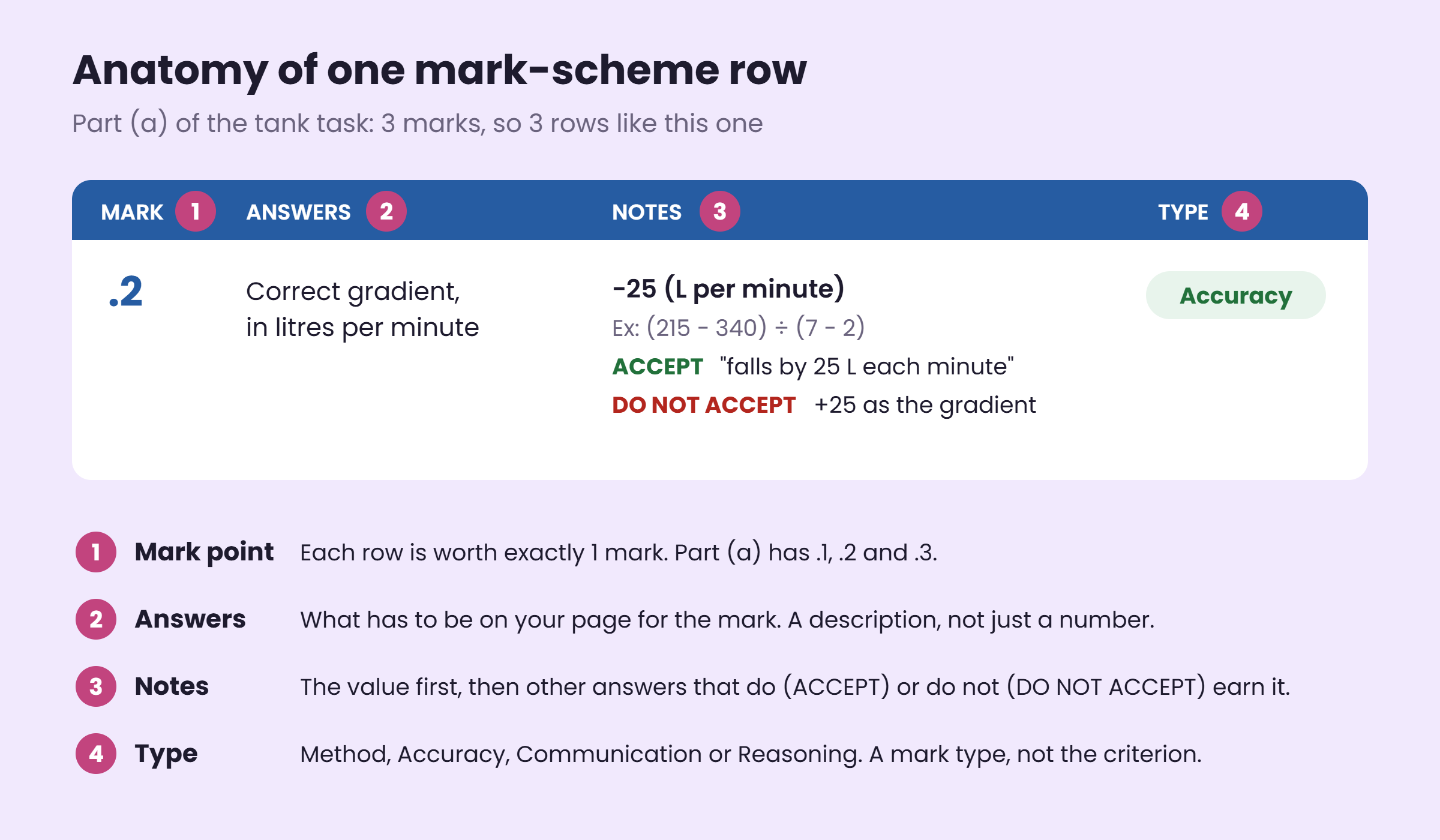
You will also meet a few short phrases:
Error carried forward is the rule that matters most to students, and the one most often misunderstood. It means a mistake is punished once. If your later working is correct for the value you had, it still earns its marks.
There is a catch: an examiner can only carry your error forward if they can see it. Here are two students who made exactly the same arithmetic slip on the task you will try below.
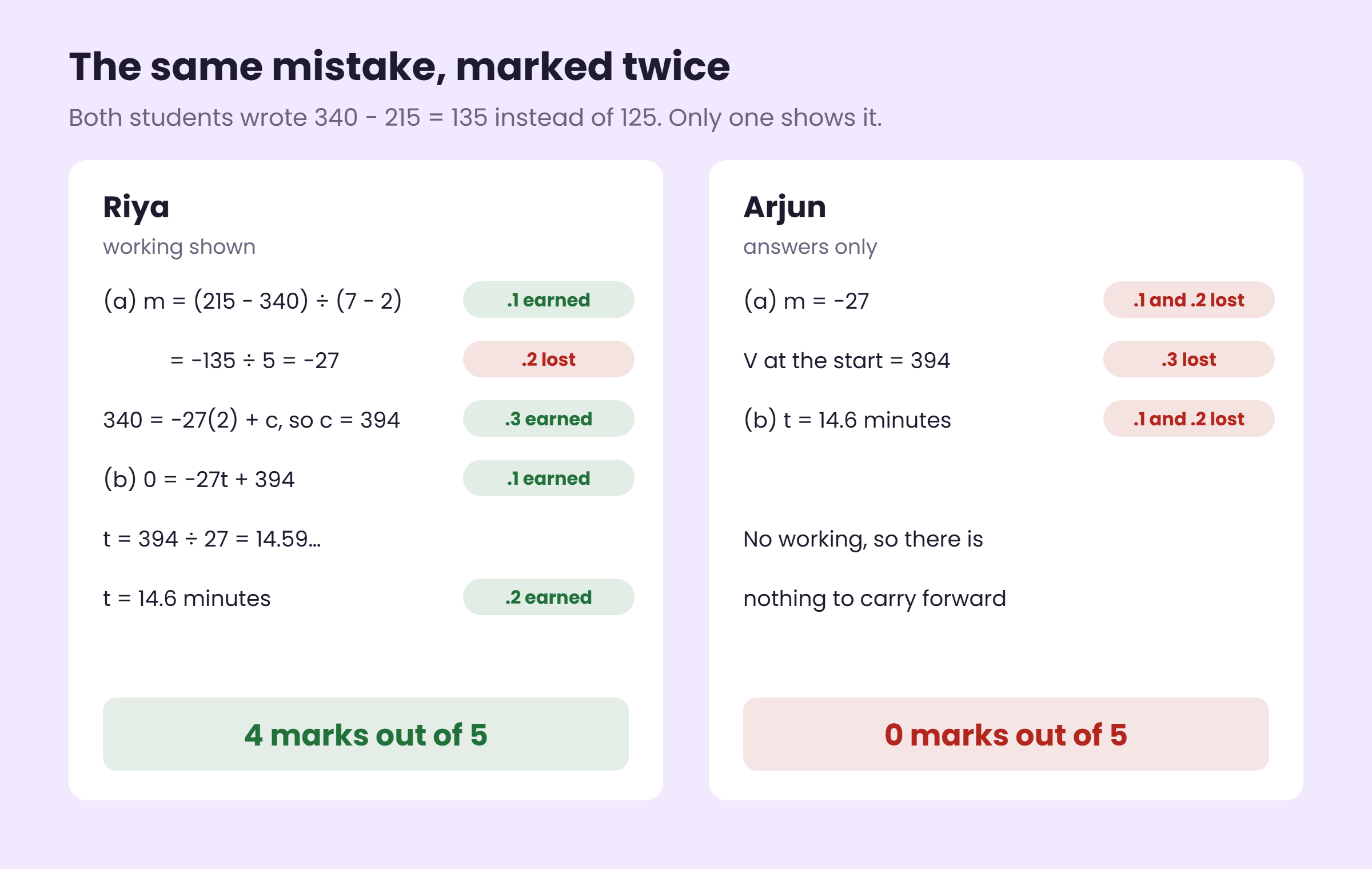
Same slip, same final answer, 4 marks apart. Riya's later steps are correct for her gradient of −27, so the marker gives them. Arjun's 394 and 14.6 could have come from anywhere, so there is nothing to carry forward. Showing working is not neatness. It is insurance.
The longest parts of a paper, usually the Criterion B investigation and the Criterion D report, are often marked with a level table instead of separate rows. The table is split into categories (for example Patterns, General rule, Verification, Justification, Communication), and each category has numbered levels.
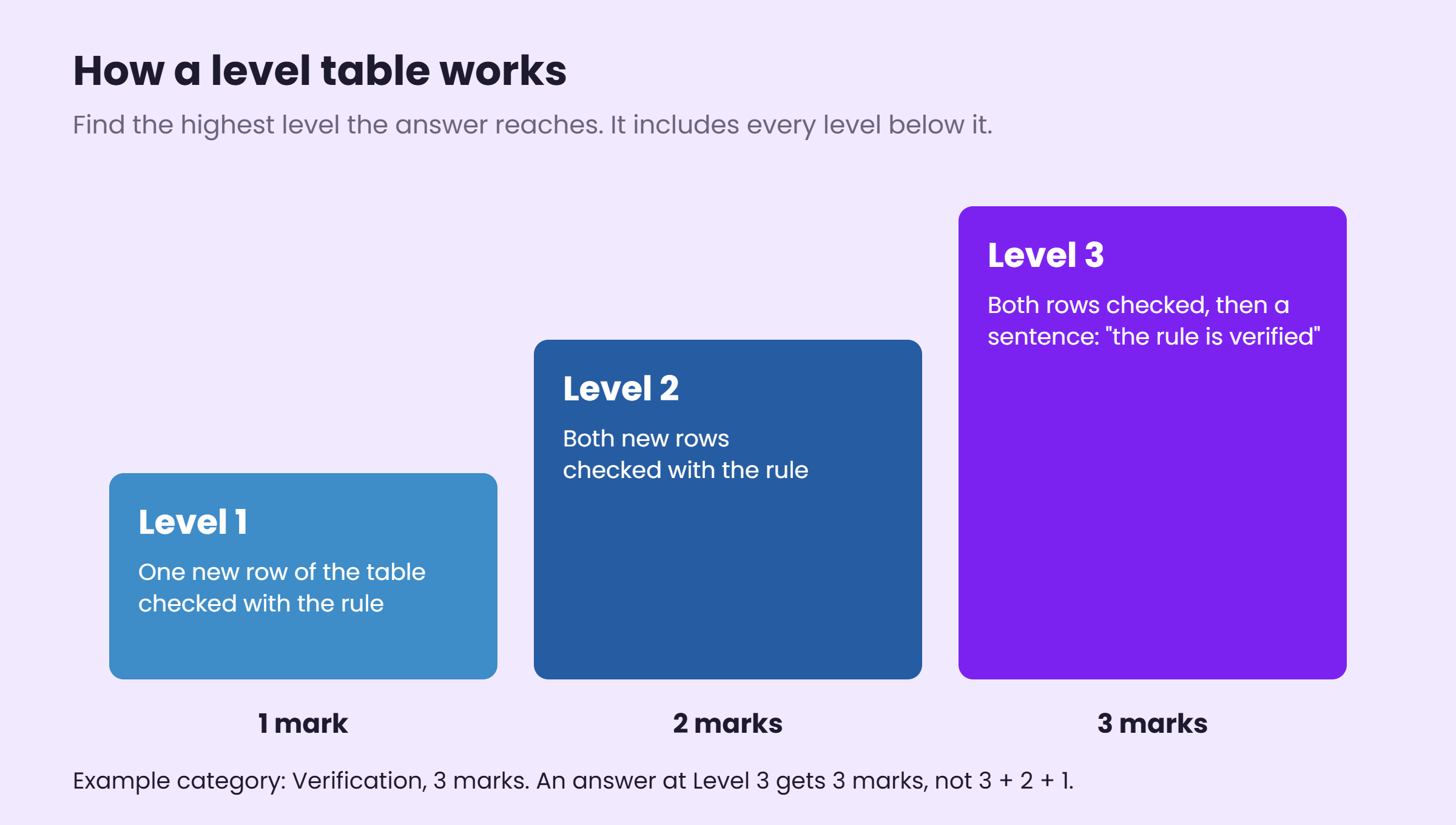
Two things trip students up:
Communication categories often count items instead: "one of the four items below" is level 1, "all four" is level 4. Each item is something specific you can check, such as a pattern described in a full sentence or a rule with its variables defined.
First solve the task yourself. Then mark Riya's answer with the mark scheme, row by row, before you open the solution.
Task: The water tank (5 marks)
A tank is emptied through a tap at a constant rate. Two minutes after the tap is opened, the tank holds 340 litres. Seven minutes after the tap is opened, it holds 215 litres.
The volume, V litres, after t minutes is modelled by V = mt + c.
(a) Calculate the values of m and c. [3 marks]
(b) Determine how long after the tap is opened the tank is empty. Give your answer correct to 3 significant figures. [2 marks]
Riya's answer
The mark scheme
| Mark | Answers | Notes | Type |
|---|---|---|---|
| (a) 3 marks | |||
| .1 | Gradient from the two readings | (215 − 340) ÷ (7 − 2) OE | Method |
| .2 | Correct gradient | m = −25 ACCEPT "falls by 25 L each minute" DO NOT ACCEPT +25 | Accuracy |
| .3 | Correct starting volume | c = 390 Ex: 340 = 2 × their m + c ACCEPT their m (ECF) | Accuracy |
| (b) 2 marks | |||
| .1 | Sets V = 0 in their model | 0 = their m × t + their c OE ACCEPT their values (ECF) | Method |
| .2 | Time to 3 s.f., with the unit | 15.6 minutes ACCEPT their values (ECF) DO NOT ACCEPT a missing unit or a negative time | Communication |
Extension. Riya's friend says, "Her final answer is wrong, so part (b) should get 0." Use the mark scheme to write a two-sentence reply. Then decide: if Arjun had written just one more line in part (a), which line would have saved him the most marks?
The correct answer first. m = (215 − 340) ÷ (7 − 2) = −125 ÷ 5 = −25. Then 340 = −25(2) + c, so c = 390. Check with the other reading: −25(7) + 390 = 215. For (b), 0 = −25t + 390, so t = 390 ÷ 25 = 15.6 minutes.
Riya, part (a)
Riya, part (b)
Total: 4 marks out of 5. One arithmetic slip cost one mark.
The extension. A good reply: "Error carried forward means a mistake is only punished once. Riya's part (b) is correct for the model she found in part (a), and the mark scheme says to accept her values, so both marks stand." For Arjun, the single most valuable line is the gradient working, (215 − 340) ÷ (7 − 2). It earns .1 on its own and gives the marker a visible value to carry forward. With his c = 394 shown as 340 = −27(2) + c, and his part (b) equation written down, he would have matched Riya's 4 marks.
Screenshot this and keep it next to you whenever you mark a practice paper. Not sure where to get practice papers in the first place? Here is where MYP maths past papers really are, and how to use them.
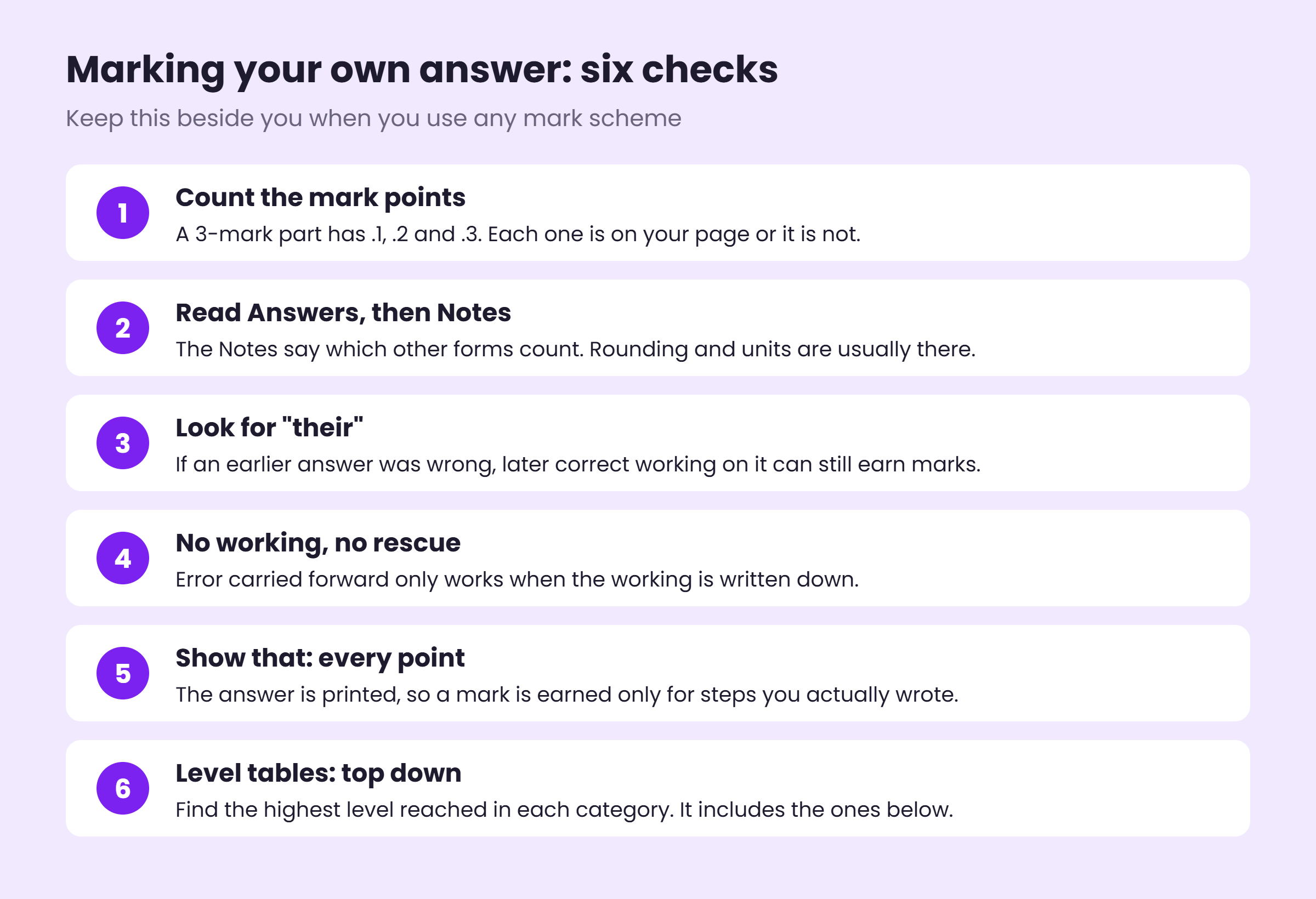
Then do one more thing that most students skip: write your marks for each criterion, not just a total. A 68 tells you very little. "A 22, B 14, C 17, D 15" tells you to spend the next fortnight on investigations.
Want full papers marked this way? Our IB MYP Standard Maths practice papers come with a mark scheme in exactly this layout, and you can try the free sampler first.
 Launch your Graphy