There are no items in your cart
Add More
Add More
| Item Details | Price | ||
|---|---|---|---|

Write down, Calculate, Determine, Show that, Verify, Justify. What each command term asks for, with one situation asked five ways and an original task to practise on.
Tue Oct 13, 2026
You knew the maths. You got the right number. The mark scheme still gave you one mark out of three, because the question said Show that and you wrote the answer first and worked backwards from it. Or it said Justify and you gave a calculation. Or it said Write down and you spent four minutes on working that nobody was ever going to mark.
In MYP maths, the first word of a question is part of the question. It tells you what your answer has to look like, how much working the examiner expects and, very often, where the Criterion C marks are.
THE SHORT ANSWER
Every MYP maths command term tells you two things: how much working to show, and what form your answer must take. Write down and State need the answer only. Calculate, Find and Determine need working and an answer. Show that gives you the answer, so the working is what earns the marks. Verify, Justify, Explain and Comment are marked on your reasons, written in words.
Command terms are not exam jargon made up for the test. The IB publishes one official list for every MYP subject, in Appendix 3 of MYP: From principles into practice, and maths uses the same definitions as everyone else. These are the ones you meet most often in MYP 4 and 5 maths, with the official wording.
| Command term | Official IB definition | What it means for your answer |
|---|---|---|
| Write down | "Obtain the answer(s), usually by extracting information. Little or no calculation is required. Working does not need to be shown." | Read it off or spot it. One line. |
| State | "Give a specific name, value or other brief answer without explanation or calculation." | The answer and nothing else. |
| Calculate | "Obtain a numerical answer showing the relevant stages in the working." | A number, with the steps that got you there. |
| Find | "Obtain an answer showing relevant stages in the working." | Like Calculate, but the answer can be an expression. |
| Solve | "Obtain the answer(s) using algebraic and/or numerical and/or graphical methods." | Every value that works, by any sound method. |
| Determine | "Obtain the only possible answer." | Commit to one answer, and be sure it is the only one. |
| Hence | "Use the preceding work to obtain the required result." | Your last answer is the starting point. Use it. |
| Show that | "Obtain the required result (possibly using information given) without the formality of proof." | You already know the answer. Prove you can reach it. |
| Prove | "Use a sequence of logical steps to obtain the required result in a formal way." | Every line follows from the line before. |
| Verify | "Provide evidence that validates the result." | Check that it works, and show the check. |
| Justify | "Give valid reasons or evidence to support an answer or conclusion." | Say why it must be true. |
| Describe | "Give a detailed account or picture of a situation, event, pattern or process." | What happens, in words. |
| Explain | "Give a detailed account including reasons or causes." | What happens and why it happens. |
| Comment | "Give a judgment based on a given statement or result of a calculation." | Agree or disagree, and back it with a number. |
| Estimate | "Obtain an approximate value for an unknown quantity." | A sensible rounded value, with how you got it. |
Two of these are worth reading twice. Determine is not a fancier word for Calculate. "The only possible answer" means the examiner wants you to commit to one value and, when that is not obvious, to say why no other value works. And Show that is the only common command term that hands you the answer before you start, which changes how the whole answer has to be written.
Learning fifteen definitions by heart is slow. It is quicker to sort the terms into six families by one question: what earns the marks?
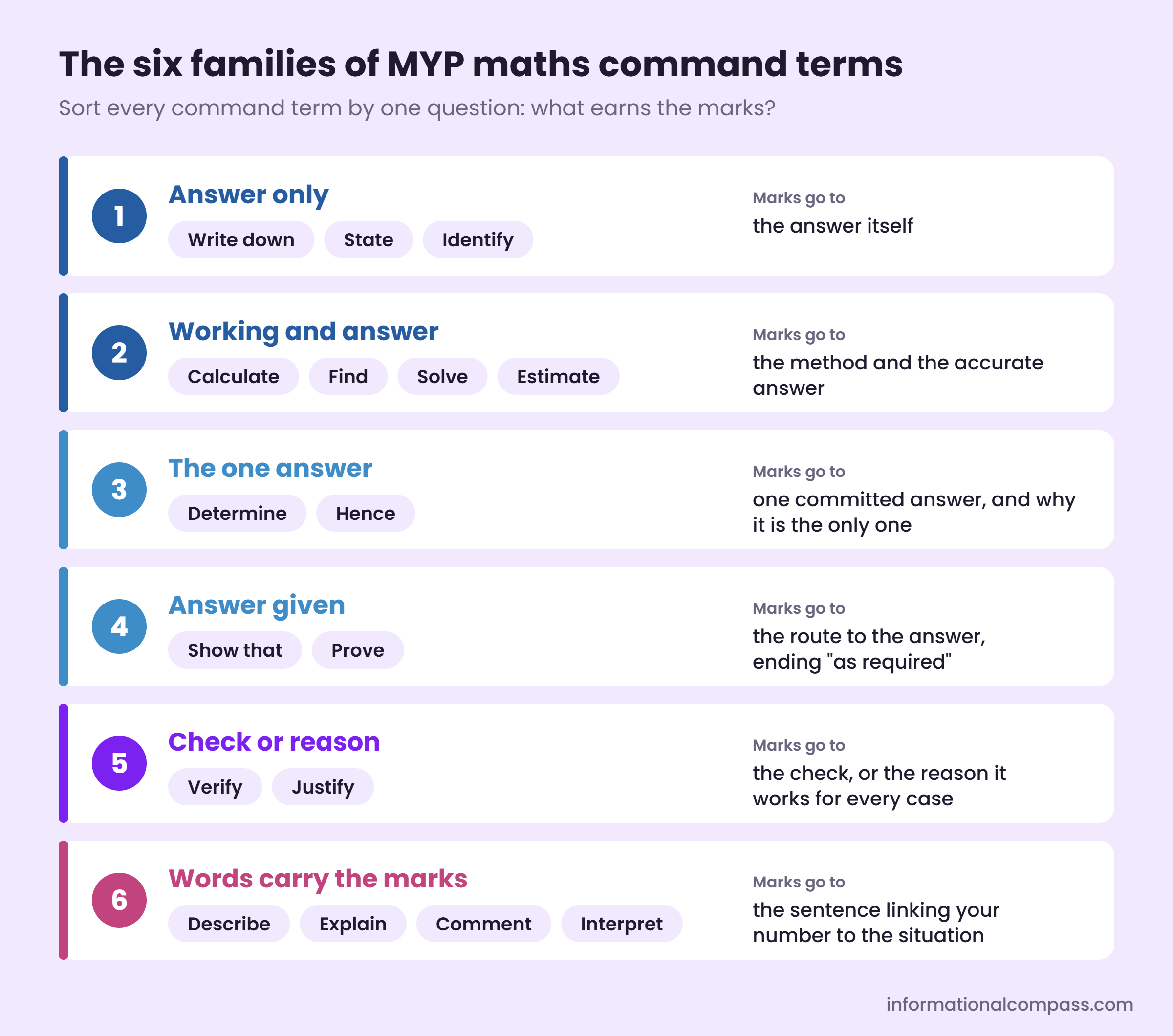
1. Answer only: Write down, State, Identify. Usually one mark. The answer is the mark, so give it clearly, with units, and move on. Short working does no harm, but every minute spent here is a minute taken from a part that pays more.
2. Working and answer: Calculate, Find, Solve, Estimate. Usually two or three marks, split between method and accuracy. If your final answer is wrong and you showed no working, there is nothing left on the page for the examiner to give a mark for.
3. The one answer: Determine, Hence. Working, a single committed answer and, where the question is about a maximum, a minimum or a unique value, a reason why it is the only one. Hence adds one more rule: the method must come from your previous part.
4. Answer given: Show that, Prove. The result is printed in the question, so writing it down earns nothing. The marks are for the route from what you know to what you were given, and the last one is usually for the closing line: "..., as required."
5. Check or reason: Verify, Justify. These look alike and are marked very differently. Verifying is checking that a result works in a particular case. Justifying is showing why it must work in every case. We took this pair apart in detail in Verify or Justify? The two words that decide your MYP Criterion B level, so here they get one example each.
6. Words carry the marks: Describe, Explain, Comment, Interpret. A number on its own scores little here. These parts are where much of Criterion C (Communicating) and the reasoning in Criterion D sit, and the mark goes to the sentence that connects your number to the situation.
Drawing terms (Draw, Sketch, Plot, Construct) form their own small group. Draw means accurate and to scale; Sketch means the right shape with the key features labelled. If you only remember one thing about them, remember that a sketch with no labels has thrown away most of its marks.
QUICK CHECK: WHICH FAMILY?
Six questions written the way an exam writes them. Decide the family for each one, then tap to check.
Family 1, answer only. The answer is −7, read straight from the equation. No working is needed.
Family 2, working and answer. V = πr²h = π × 4² × 10 = 502.7 cm³ (1 d.p.). The formula and substitution earn the method mark; the rounded answer with units earns the rest.
Family 4, answer given. Start from what you know: the angle sum is (6 − 2) × 180° = 720°, and 720° ÷ 6 = 120°, as required. Starting from 120° earns nothing.
Family 3, the one answer. Each exterior angle is 180° − 140° = 40°, and 360° ÷ 40° = 9. The polygon has 9 sides, and only 9 works.
Family 5, check or reason. Write the odd numbers as 2a + 1 and 2b + 1. Their sum is 2a + 2b + 2 = 2(a + b + 1), which is a multiple of 2 for every pair of whole numbers a and b. Testing 3 + 5 = 8 would only verify one case.
Family 6, words carry the marks. The mean is 60 ÷ 4 = 15, which is larger than three of the four values. The single large value 45 pulls the mean up, so it does not represent a typical value. The number alone would not score; the reason does.
The fastest way to see the difference is to keep the maths fixed and change only the first word. Here is one simple situation, asked five ways.
A taxi company charges ₹50 to start a trip, plus ₹18 for every kilometre travelled.
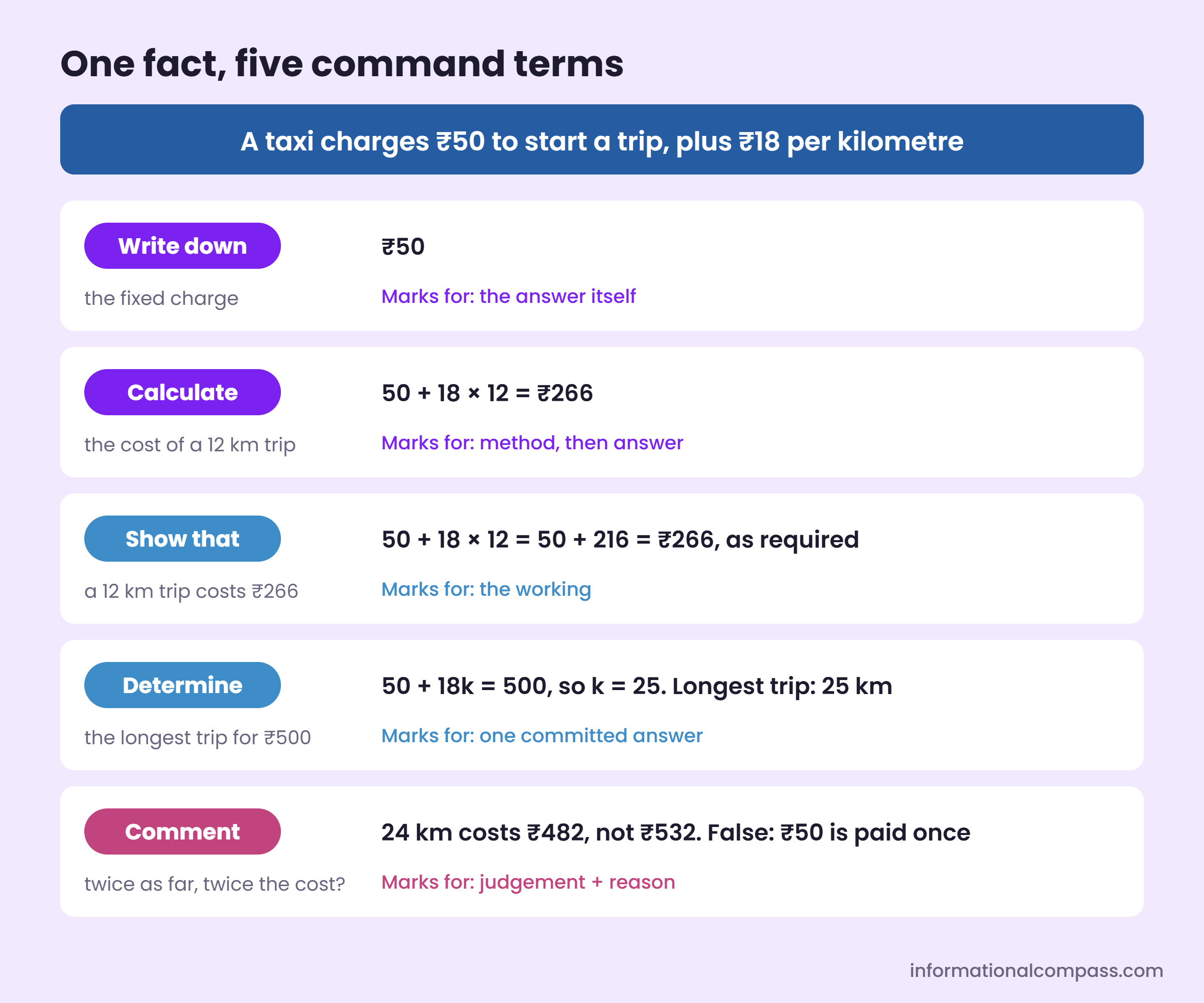
Answer each one in your head first, then tap to see what earns the marks.
₹50. That is the whole answer, worth one mark.
50 + 18 × 12 = 50 + 216 = ₹266. One mark for the method, one for the answer.
The same working, but now ₹266 is printed in the question, so the working is all you are marked on. Start from the fare rule, finish with "= ₹266, as required." Writing "266 − 50 = 216 and 216 ÷ 18 = 12" works backwards from the answer and usually earns nothing.
50 + 18k = 500, so 18k = 450 and k = 25. The longest trip is 25 km. One answer, stated as the longest, not "about 25" or "between 24 and 26".
A 24 km trip costs 50 + 18 × 24 = ₹482, which is not 2 × ₹266 = ₹532. The claim is false, because the ₹50 starting charge is paid once per trip, not once per kilometre. The judgement, the numbers and the reason are all needed.
Same taxi, same ₹18. Five different answers, and five different places the marks are hiding. That is what a command term does.
This is an original task written for this post, with eight parts and eight command terms. Before you answer anything, underline the command term in each part and decide which family it belongs to. It takes ten seconds and it is the habit this whole post is about.
PRACTICE TASK: THE GARDEN AGAINST THE WALL (15 MARKS)
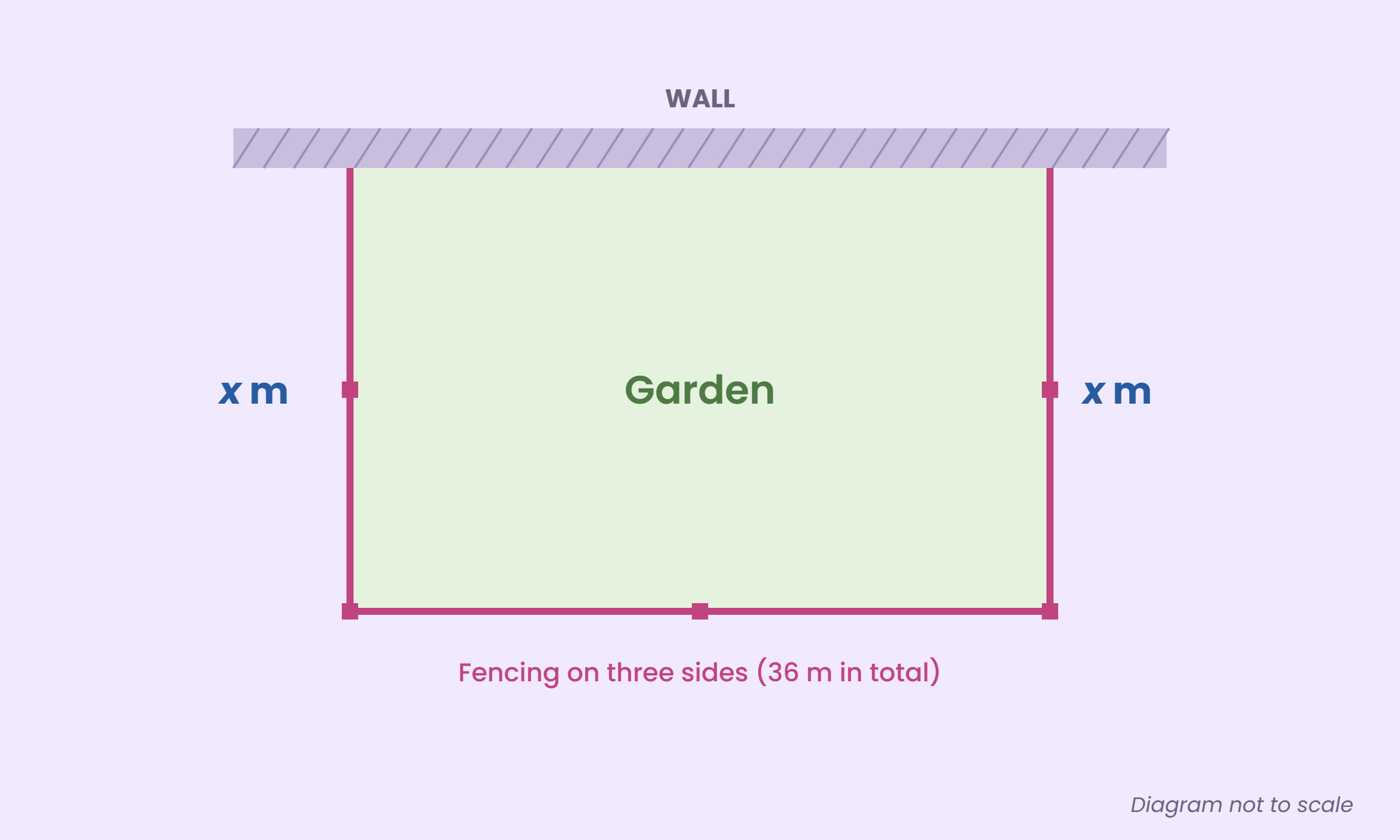
A school is fencing a rectangular vegetable garden against a straight wall of the school building. The wall forms one side of the garden, so fencing is needed on the other three sides only. There are 36 m of fencing, and all of it is used.
The two sides at right angles to the wall are each x metres long.
Stuck? Open one hint at a time.
What length is left for the side along the wall? It cannot be zero or negative.
Area is length × width. Write the product of the two sides before you expand anything.
Write any other width as x = 9 + d, where d can be positive or negative, and expand the area.
Parts (e) and (f) are the heart of the task. They ask about the same value of x in two different ways, and only one of them can be answered with three multiplications.
Check one part at a time, so a later answer does not give away an earlier one.
The two sides at right angles to the wall use 2x metres, so the side parallel to the wall is 36 − 2x metres. No working is needed for the mark.
The side parallel to the wall must have a positive length, so 36 − 2x > 0, which gives x < 18. If x were 18, the two short sides would use all 36 m of fencing and there would be nothing left for the third side.
Side parallel to the wall = 36 − 2 × 7.5 = 21 m
Area = 7.5 × 21 = 157.5 m²
One mark for multiplying the correct two lengths, one for 157.5 m². Leaving out the units is a common way to drop the second mark.
Area = length × width
A = x(36 − 2x)
A = 36x − 2x², as required.
The line A = x(36 − 2x) is what earns the method mark, because it shows where the formula comes from. Copying out the formula from the question earns nothing.
When x = 8.5: A = 8.5 × 19 = 161.5 m²
When x = 9: A = 9 × 18 = 162 m²
When x = 9.5: A = 9.5 × 17 = 161.5 m²
162 > 161.5, so x = 9 gives a larger area than both x = 8.5 and x = 9.5, as required.
This is complete for part (e). But notice what it does not tell you: nothing at all about x = 9.2, or x = 4, or any value you did not try.
Write any width as x = 9 + d, where d can be any number, positive or negative.
Side parallel to the wall = 36 − 2(9 + d) = 18 − 2d
A = (9 + d)(18 − 2d)
A = 162 − 18d + 18d − 2d²
A = 162 − 2d²
Because d² is never negative, 2d² is never negative either, so A can never be more than 162. A equals 162 only when d = 0, that is, when x = 9. Therefore no value of x gives a larger area than x = 9.
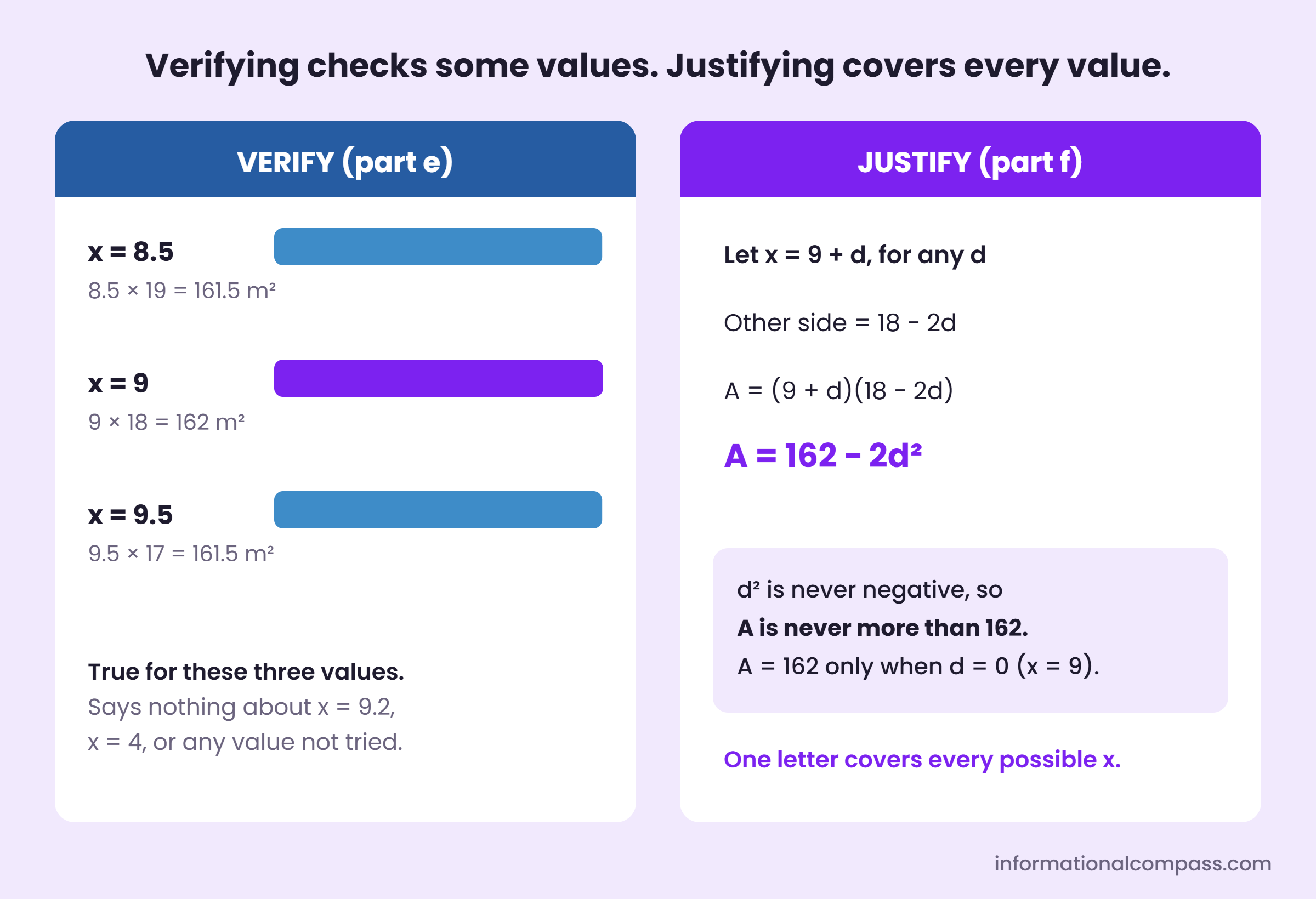
Set the two answers side by side. Part (e) used three numbers. Part (f) used a letter, d, that stands for every possible change at once. That is the whole difference between verifying and justifying, and it is why (f) carries more marks.
From (f), the largest area is when x = 9. The side parallel to the wall is then 36 − 2 × 9 = 18 m.
The largest garden is 18 m long (along the wall) and 9 m wide, with an area of 162 m².
"Hence" means the answer must come from part (f), and "determine" means one answer. Part (f) is what makes it the only possible one.
A square garden needs x = 36 − 2x, so x = 12. That gives a 12 m by 12 m square with area 144 m², which is less than the 162 m² found in (g).
The claim is false for this garden. The square rule works when fencing goes all the way round, but here the wall acts as a free fourth side, and the best garden is twice as long as it is wide.
A judgement, a number from your working and a reason: all three are needed for both marks.
SCORE YOURSELF OUT OF 15
13 to 15: you are reading command terms the way an examiner does. Next, practise them across a whole paper: here is where to find MYP maths past papers and how to use them.
9 to 12: look at which parts lost marks and find their family in the diagram above. It is usually one family, not many.
8 or fewer: go back to the six families and the taxi example, then try the task again tomorrow without the hints.
The first few words of your answer show the examiner which job you are doing. These starters work for almost any question, so keep them where you can see them while you revise.
| If the question says | Your answer should look like |
|---|---|
| Write down / State | The answer, with units. Nothing more. |
| Calculate / Find | Formula, then substitution, then the answer with units and the rounding asked for. |
| Determine | Working, one answer, then "This is the only ___ because ___." when that is in question. |
| Show that | Start from what you know. End with "..., as required." Never start from the answer. |
| Verify | "Using the rule: ___. Working directly: ___. These agree, so ___ is verified." |
| Justify | "Because ___, ___ must be true for every ___." |
| Describe | "As ___ increases, ___ ..." (what happens, no reason needed) |
| Explain | "___ happens because ___." |
| Comment | "The claim is true / false, because ___ (a number from your working)." |
Notice how short most of them are. A command term rarely asks you to write more. It asks you to write the right thing.
Command terms are the instruction words at the start of a question, such as Calculate, Show that or Justify. The IB publishes an official definition for each one, and every MYP subject uses the same list. Each term tells you how much working to show and what kind of answer earns the marks.
Calculate asks for a numerical answer with the stages of working shown. Determine asks for the only possible answer, so you commit to a single value and, when the question is about a maximum, a minimum or a unique value, you show why no other value works.
No. Both give you the result in the question, but Show that asks you to reach it "without the formality of proof", in clear steps. Prove asks for a formal chain of logical steps. In MYP 4 and 5 maths papers, Show that is far more common.
No. The official definition says that working does not need to be shown. The answer alone earns the mark, so give it clearly with units and move on.
Communication marks usually sit in Explain, Justify and Comment answers, the closing line of a Show that, and the units, rounding and final statement in context of a calculation. Writing these clearly is where many students pick up marks they did not know they were losing.
The habit to build is small. Before you write anything, read the first word of the question and ask: what earns the marks here? The answer, the working, the route, or the reason. Get that right and your maths finally gets the marks it deserves.
Want to practise every command term under exam conditions?
Each of the three papers in IB MYP Standard Mathematics eAssessment Practice Papers, Volume 1 uses the full range of command terms, with a typed model answer and an examiner-style mark scheme that shows where every mark is earned.
 Launch your Graphy